1. A Human Story
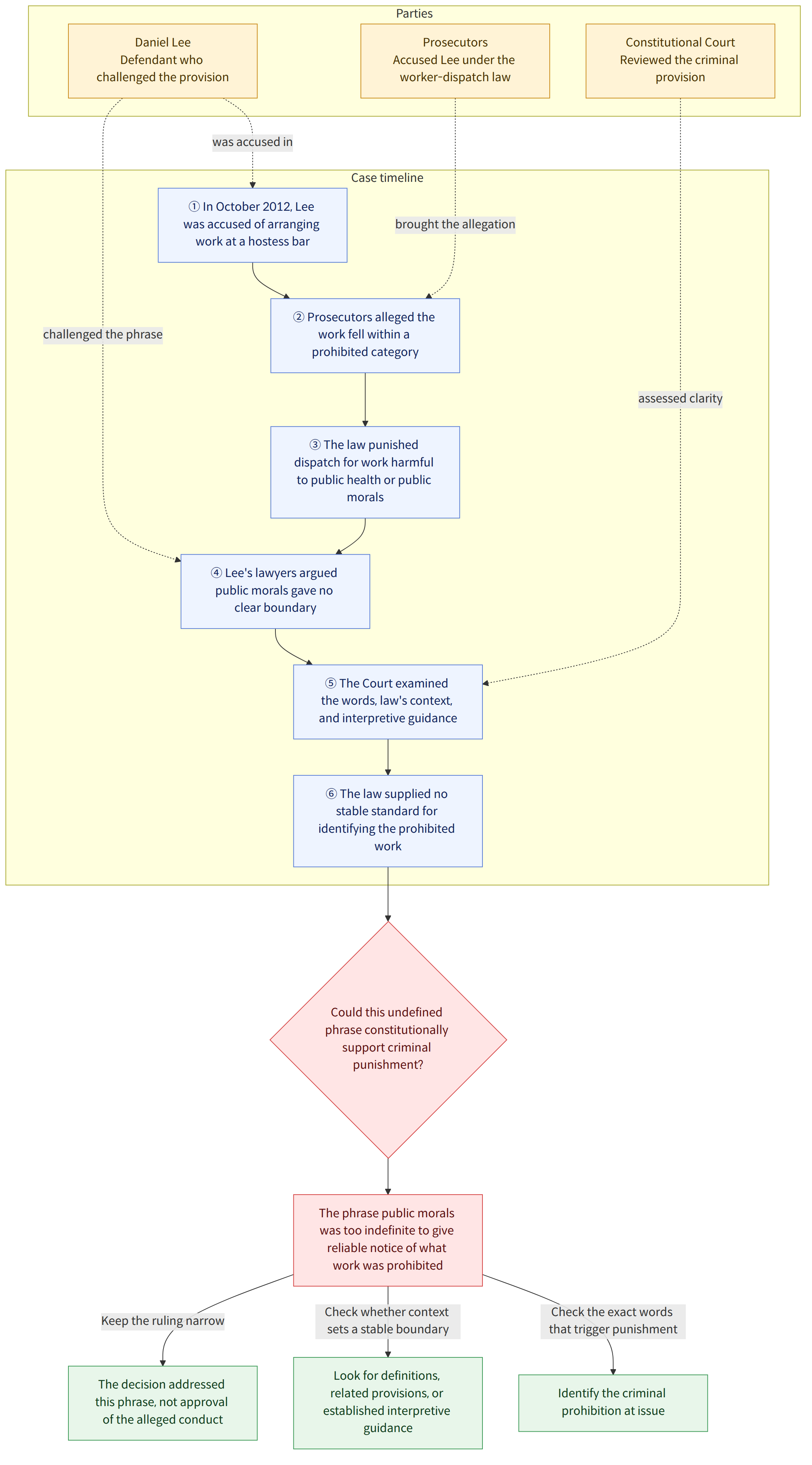
In October 2012, Daniel Lee, who arranged workers for entertainment businesses, was accused of sending foreign women to a hostess bar where they were made to engage in prostitution. The women had crossed borders for work; Daniel’s alleged role was to place them in a business whose activities, prosecutors said, fell within a prohibited category under Korea’s worker-dispatch law.
The case did not turn only on what happened at the bar. The law punished a person who dispatched workers for the purpose of having them employed in work harmful to public health or “public morals.” Daniel’s lawyers challenged that second phrase. They argued that a person could not know, from the words of the law, what work counted as harmful to public morals—and that criminal punishment could not rest on such an uncertain boundary.
2. The Legal Question
Could Korea constitutionally punish someone under a criminal provision that used the phrase “work harmful to public morals” without defining it or providing a clear standard for deciding which work it covered?
3. What Korean Law Says
Korean criminal law is governed by the constitutional principle of legality: the state may punish conduct only under a law that gives people a sufficiently clear warning about what is prohibited. This is not a demand that every statute spell out every imaginable situation. But the basic meaning of a criminal prohibition must be knowable in advance, rather than left to unpredictable judgment after the event.
The Constitution provides that no person may be prosecuted for an act that was not a crime under a statute in force when it was committed.
This principle is often described as “no crime and no punishment without law.” Its clarity requirement helps people make choices and limits arbitrary enforcement. A vague phrase is especially troubling when it forms part of a criminal offence, because conviction may lead to punishment and a lasting criminal record.
The provision in Daniel’s case appeared in the Act on the Protection, etc. of Temporary Agency Workers. It penalized dispatching workers for the purpose of employment in work harmful to public health or public morals. The constitutional question focused on the words about public morals—not on whether prostitution is lawful or on every other possible offence connected to the alleged conduct.
In examining whether the phrase was clear enough, the Constitutional Court considered whether a person could find a workable meaning by looking at:
- The ordinary meaning of “public morals” and “harmful.”
- The purpose and overall structure of the worker-dispatch law.
- Definitions, surrounding words, or related provisions that might narrow the category.
- Established guidance from responsible authorities or a consistent way for judges to interpret the phrase.
The Court concluded that these sources did not supply a sufficiently definite standard. “Public morals” can change with social values, customs, and circumstances. The law did not define the expression, qualify it with more precise language, or offer an established interpretive guide that made the prohibited work identifiable.
The Court’s core point was that this phrase did not give an ordinary person a reliable enough standard to decide what conduct the criminal law prohibited.
4. How Korean Courts Approach This
Korean courts generally recognize that legislation sometimes uses broad language. A term does not become unconstitutional simply because it requires interpretation. The key question is whether its meaning can be made reasonably clear by reading the words in context, considering the statute’s purpose and related provisions, and applying established legal standards.
But a criminal prohibition cannot leave the decisive question—what conduct is forbidden—to open-ended moral judgment. If neither the text nor the legal context provides a stable standard, people cannot reliably know where the line lies, and enforcement risks varying from one case to another. In that situation, the constitutional clarity requirement may be violated even if the legislature was pursuing a legitimate public-interest goal.
The Court’s ruling on this provision therefore did not amount to approval of the alleged conduct. It addressed a narrower question: whether this particular phrase could constitutionally serve as the basis for criminal punishment.
5. Applying the Law to the Case
The reasoning in Daniel’s case proceeds in several steps.
- Identify the language that triggers punishment. The charge relied on the worker-dispatch law’s prohibition against sending workers to jobs harmful to public health or public morals. The disputed category was “public morals.”
- Ask whether the words themselves set a usable boundary. “Public morals” is a broad, changing idea. Without further explanation, it does not tell a recruiter, employer, or worker exactly which kinds of work fall within the criminal prohibition.
- Look for clarification elsewhere in the law. The statute did not define “work harmful to public morals,” and it did not add a narrowing description that would make the category more precise. Its general purpose—regulating worker dispatch—could not by itself resolve the uncertainty.
- Check for an established interpretive standard. The Court found no settled guidance from relevant authorities and no dependable method by which judges could clarify the phrase without supplying their own uncertain value judgments.
- Apply the constitutional rule. Because the law did not give ordinary people a sufficiently clear standard for deciding what work was criminally prohibited, the phrase failed the constitutional requirement of clarity for criminal laws.
That conclusion did not settle every factual or legal issue in Daniel’s prosecution. It did not decide whether the allegations were true, whether another criminal provision might apply, or whether other charges could be proved. It meant that punishment could not rest on this unconstitutional phrase.
6. Conclusion: What Happened, and What Should You Do?
The Constitutional Court held that the words “work harmful to public morals” in the relevant worker-dispatch provision were too unclear to support criminal punishment. For Daniel, that meant the charge could not be sustained on that provision alone. Any separate allegations or charges would have to be considered independently under laws that clearly cover the conduct alleged.
For readers facing a similar investigation or charge:
- Get advice promptly from a Korean criminal-law lawyer. Ask which exact statutory provisions support each charge, rather than treating the case as one undivided accusation.
- Preserve the relevant records. Keep contracts, messages, payment records, work descriptions, and documents showing who arranged or controlled the work.
- Do not assume one ruling resolves every issue. A constitutional challenge to one phrase may defeat reliance on that provision, but separate offences and immigration or employment-law consequences require their own analysis.