1. A Human Story
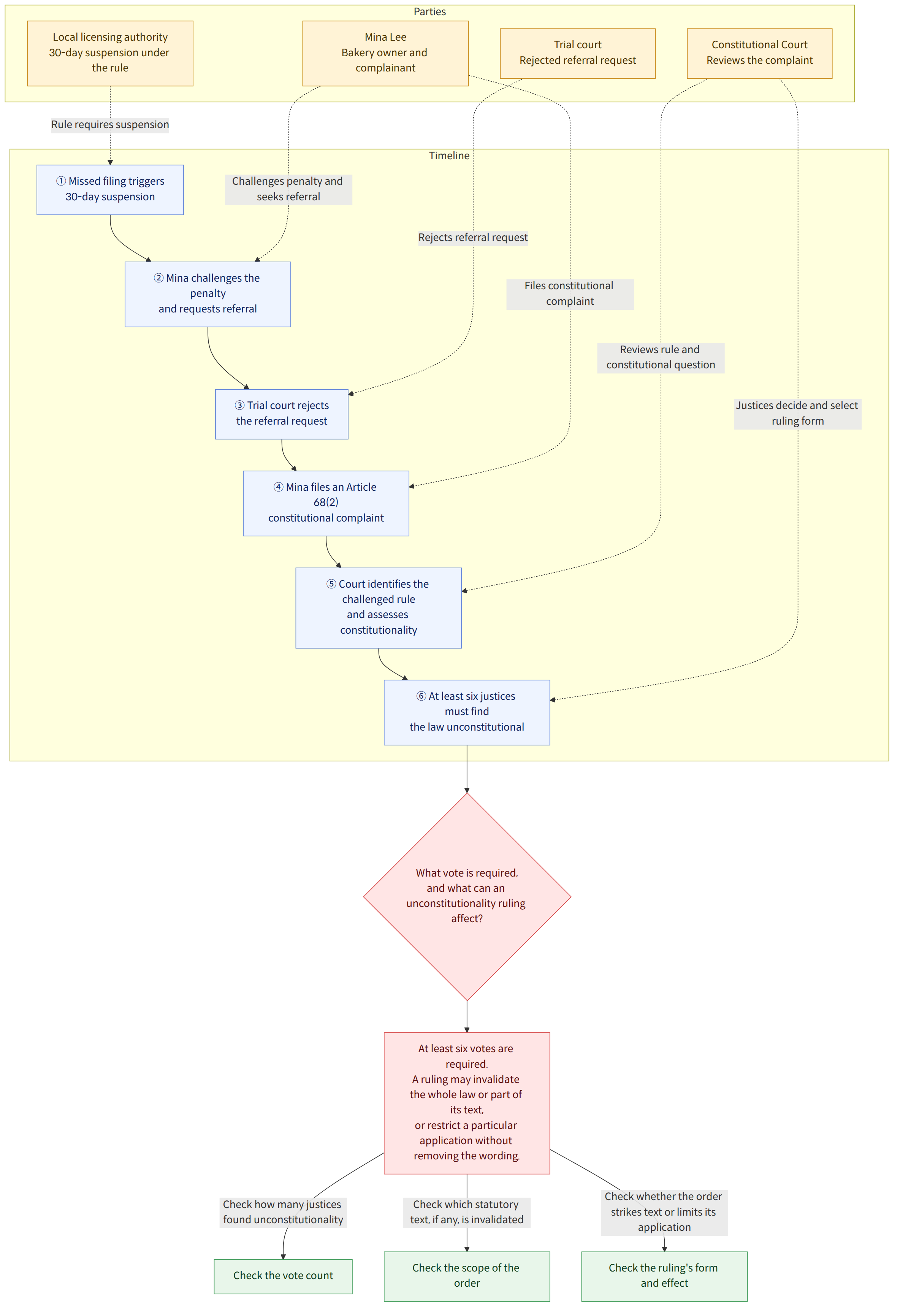
Mina Lee had built her small bakery around early mornings and careful routines. Then a missed filing deadline triggered a local licensing rule that required a 30-day suspension, even though Mina had corrected the paperwork as soon as she discovered the mistake.
She challenged the penalty in court and asked the judge to refer the law to the Constitutional Court for review. The judge rejected that request. Mina then filed a constitutional complaint under Article 68(2) of the Constitutional Court Act. She was not asking the Court to decide whether she had missed the deadline; she wanted to know whether the law that dictated the punishment could stand.
As the case moved forward, Mina asked a practical question: what would have to happen for the Constitutional Court to declare the rule unconstitutional—and would the whole rule disappear, or only the part affecting her?
2. The Legal Question
When the Constitutional Court reviews a statute through a complaint under Article 68(2), what level of support is required for an unconstitutionality decision, and what happens to the law if the Court finds it unconstitutional in whole or in part?
3. What Korean Law Says
Article 68(2) provides a route to constitutional review when a party in a court case has requested a referral on whether an applicable statute is constitutional, but the court rejects that request. The party may then bring a constitutional complaint to the Constitutional Court, subject to the statutory procedure and deadline.
The decisive voting threshold is not an ordinary majority. At least six Constitutional Court justices must find the law unconstitutional for the Court to issue an unconstitutionality decision.
The central rule is that a law—or an identified part of it—is declared unconstitutional when six or more justices reach that conclusion.
An unconstitutionality ruling need not cover an entire statute. Depending on what the Court reviews and how the relevant text is structured, it may concern:
- the whole law;
- a separate article or provision;
- a paragraph or clause within a provision; or
- particular words or a portion of a sentence.
When the Court strikes down statutory text, the invalidated law or part ordinarily loses legal force. A partial unconstitutionality decision therefore removes only the portion identified by the Court, rather than automatically wiping out every other part of the statute.
There is also a different kind of ruling. The Court may leave the statutory wording in place but declare that applying it in a particular way or to a particular situation is unconstitutional. This is commonly described as a qualitative partial unconstitutionality decision and is a form of modified decision. It differs from a ruling that removes words or provisions from the statute itself.
Read the operative order carefully: a ruling that invalidates statutory text and a ruling that limits how the text may be applied do not have the same form or effect.
4. How Korean Courts Approach This
The Constitutional Court first identifies the precise legal rule challenged and the constitutional question raised by that rule. It then considers whether the statute, as written or as applied in the relevant setting, conflicts with the Constitution. A claim that a law seems harsh or inconvenient is not, by itself, enough; the Court must find a constitutional defect.
The six-justice threshold matters at the final stage. If fewer than six justices conclude that the law is unconstitutional, the Court cannot issue the formal unconstitutionality order described here, even if a substantial number of justices have concerns about the law.
Where only a part of a statute is defective, the Court may limit its decision to that part if it can be separated from the rest. In other cases, the constitutional problem may lie not in the words themselves but in a particular application of them. The Court’s chosen form of decision reflects that distinction, and the exact wording of its order defines what has been invalidated or restricted.
5. Applying the Law to the Case
Mina’s complaint raises two questions: whether the licensing rule violates the Constitution and what remedy follows if the Court agrees.
- The case reaches constitutional review. The trial court rejected Mina’s request to refer the statute. That rejection opened the Article 68(2) route, assuming Mina met the applicable filing requirements.
- The Court examines the challenged rule. Mina argues that a mandatory suspension for any late filing, with no opportunity to correct the error, imposes an excessive consequence. The Court must assess the constitutional merits; the severity of the outcome alone does not predetermine them.
- The votes determine whether an unconstitutionality order is available. If six or more justices conclude that the challenged rule violates the Constitution, the Court may issue such an order. If fewer than six do so, it cannot issue that formal declaration on the basis of those votes.
- The scope of the defect determines the scope of the ruling. If the constitutional flaw lies in the provision requiring an automatic 30-day suspension, the Court could invalidate that provision while leaving unrelated licensing rules untouched. If the text is not itself the problem but its use in a specific situation is, the Court could instead issue a modified decision addressing that application.
For this fictional case, suppose six or more justices conclude that the automatic-suspension provision is unconstitutional, while the rest of the licensing law can continue to operate. The appropriate result would then be a partial unconstitutionality decision directed at that provision—not a declaration that the entire licensing statute is invalid.
6. Conclusion: What Happened, and What Should You Do?
In Mina’s case, the Constitutional Court finds the automatic-suspension provision unconstitutional by the required six votes and invalidates that separable part of the law. The rest of the licensing framework remains in force. Mina therefore wins the constitutional challenge to the rule that required her suspension, although the precise effect on the penalty in her pending court case depends on the Court’s order and the procedures in that case.
For anyone considering a similar challenge:
- Check the procedural route and deadline. An Article 68(2) complaint follows the rejection of a request for constitutional referral in an ongoing court case, and filing requirements apply.
- Identify the exact words or application you are challenging. A focused argument can help clarify whether the alleged defect concerns the whole law, one provision, or a particular use of it.
- Read the operative order, not just headlines. It tells you whether statutory text has lost force or whether the Court has instead restricted a particular application.