
The Heart of Korean Administration: The Birth of Sejong
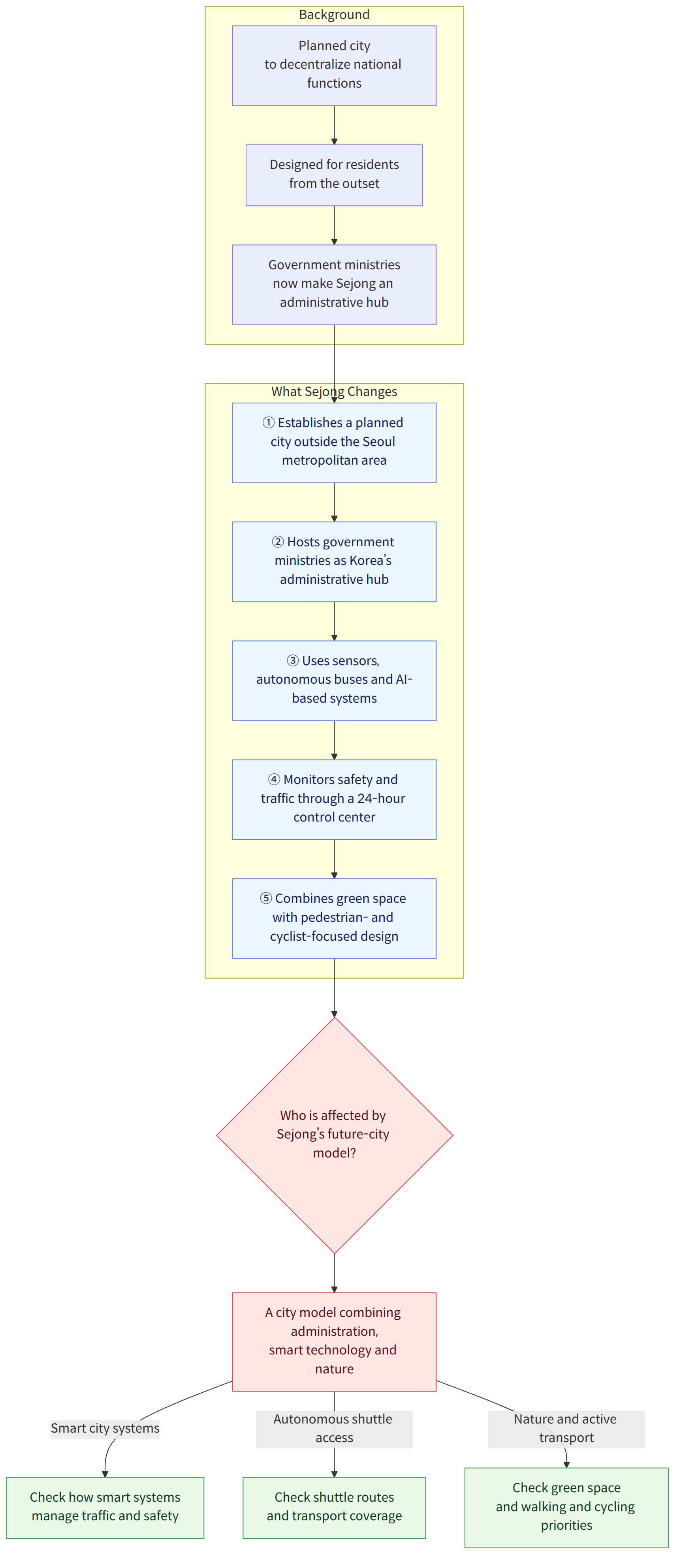
Sejong Special Self-Governing City was established as a planned city to decentralize national functions concentrated in the Seoul metropolitan area. It has now successfully established itself as the Administrative Hub of Korea, hosting various government ministries.
Beyond being a workplace for civil servants, the city was meticulously designed from its inception to ensure a high quality of life for all residents. It is akin to drawing the most efficient layout for roads and buildings on a blank canvas to create an ideal urban environment.
A Living Laboratory for 'Smart City' Innovation
Sejong serves as a global benchmark for Smart Cities (cities that use advanced ICT to solve urban issues like traffic and environment), incorporating autonomous buses and AI-based management systems. Sensors installed throughout the city analyze traffic flow in real-time to optimize movement.
"Sejong is more than just a residential area; it is a giant laboratory demonstrating how future technology can make human life safer and more convenient."
Key Smart Technologies in Sejong
- Autonomous Shuttles: Driverless vehicles operating on fixed routes to eliminate public transportation blind spots.
- Intelligent Streetlights: Lights that automatically adjust brightness based on surrounding movement or light levels to save energy.
- Integrated Control Center: A 24-hour facility monitoring city safety and traffic to respond immediately to emergencies.
Human-Centric Design Coexisting with Nature
Another defining feature of Sejong is that approximately 50% of the city's total area is dedicated to green spaces. The massive Central Park and the Geumgang River provide spaces for relaxation and healing amidst the bustle of daily life.
Furthermore, the urban design prioritizes pedestrians and cyclists over automobiles, drastically improving the traffic congestion issues seen in older metropolises. This serves as a practical model for reducing fine dust and achieving carbon neutrality (balancing carbon emissions with removal to reach net-zero).