
Section 1 — A Human Story
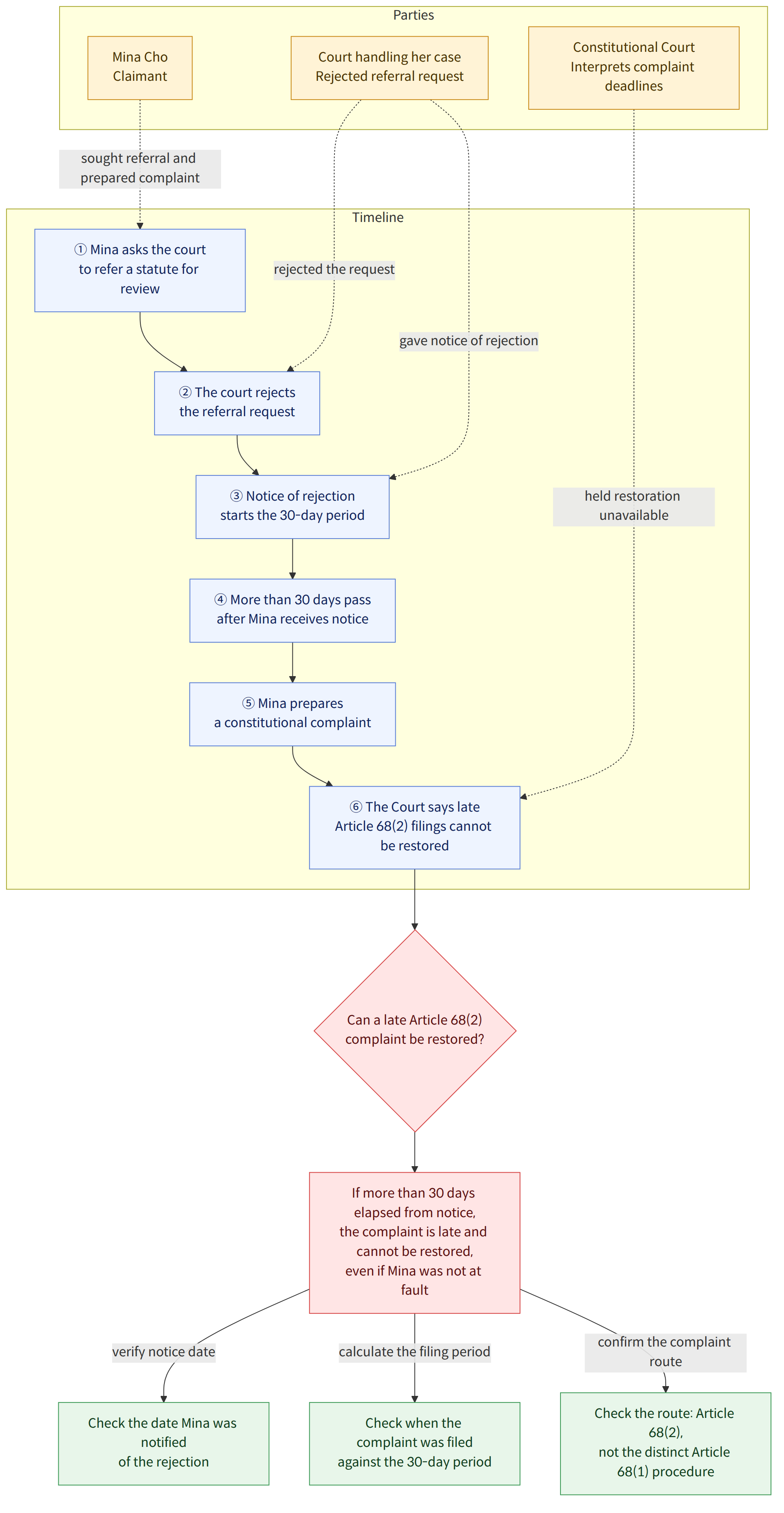
When Mina Cho opened the court’s notice, she felt that a door had closed. The court handling her case had rejected her request to refer a disputed statute to the Constitutional Court for review. She believed the statute was unconstitutional, but the immediate question was practical: what could she do next?
Mina spent the following weeks trying to understand the decision and gathering advice. By the time she prepared to file a constitutional complaint, more than 30 days had passed since she was notified that her referral request had been rejected. She wondered whether the delay could be excused because she had not understood how quickly she needed to act.
Section 2 — The Legal Question
Can someone file a constitutional complaint under Article 68(2) of Korea’s Constitutional Court Act after the 30-day period has passed—and, if the delay was not the person’s fault, can the deadline be restored?
Section 3 — What Korean Law Says
Article 68(2) provides a route to challenge the constitutionality of a statute when a party in an ongoing court case has asked that court to refer the statute for constitutional review, but the court has rejected the request. The complaint must be filed within a short, specific period.
A complaint under Article 68(2) must be filed within 30 days from the day the claimant is notified that the request for referral of the statute for constitutional review has been rejected.
The key points are:
- The relevant date is notice of the rejection, not simply the date on which the court made its decision.
- The 30-day period applies to a constitutional complaint under Article 68(2), often described as a constitutional-review complaint arising from a pending court case.
- The Constitutional Court has held that a late filing under this route cannot be restored—even where the claimant could not be held responsible for missing the deadline.
That final point is especially strict. Ordinary procedural rules may allow certain missed deadlines to be repaired in defined circumstances. But the Constitutional Court has concluded that this restoration mechanism does not apply to the Article 68(2) filing period.
For an Article 68(2) complaint, a delay may not be cured through restoration of the procedural act, even if the claimant was not responsible for the missed deadline.
This rule should not be confused with Article 68(1), a different route for seeking relief against an exercise or failure to exercise public power that allegedly violates constitutional rights. In Article 68(1) cases, the Court has recognized that a complaint may be admissible where there was a justifiable reason for missing the filing period. That more flexible approach does not carry over to an Article 68(2) complaint.
Section 4 — How Korean Courts Approach This
The Constitutional Court treats the Article 68(2) deadline as a strict procedural boundary. The route is designed to let a litigant challenge a statute after an ordinary court refuses to request constitutional review, but the opportunity must be used promptly after notice of that refusal.
The Court distinguishes between the two routes by their legal structure. Article 68(2) complaints arise from a particular step in an ongoing court case: a request for referral has been rejected. Article 68(1) complaints address a different kind of alleged constitutional violation. Because the procedures and governing rules differ, a claimant cannot rely on the more forgiving treatment of certain Article 68(1) deadline problems to rescue a late Article 68(2) filing.
The practical consequence is severe: a claimant’s lack of fault, confusion, or difficulty obtaining advice does not, by itself, reopen the Article 68(2) deadline. The first task is therefore to establish precisely when notice was given and whether the complaint was actually filed within the legally calculated period.
Section 5 — Applying the Law to the Case
Mina’s position turns on a sequence of concrete questions.
- Which procedure did she use? She sought constitutional review after a court rejected her request to refer a statute. That places her in the Article 68(2) route—not the separate Article 68(1) route.
- When did the filing period begin? The clock runs from the day she was notified of the rejection. The date printed on the court’s decision is not necessarily the date that controls.
- Had the 30-day period expired? Mina believes more than 30 days had passed after she received notice. If that calculation is correct, her complaint is late under Article 68(2).
- Can her explanation restore the deadline? Even if Mina did not understand the deadline or faced circumstances outside her control, the Court’s approach does not permit restoration of a late Article 68(2) complaint on that basis.
- Is there anything she should verify before giving up? She should immediately check the actual notice date, how and when the notice was legally delivered, the date and method of any filing, and the applicable calculation of the period. If the relevant date was misunderstood or the filing was in fact timely, the problem may be different. But if notice was validly given and the 30-day period truly expired before she filed, personal hardship alone will not make the complaint timely.
On the facts as Mina understands them, the law offers no general late-filing exception for her Article 68(2) complaint. Her belief that the statute is unconstitutional cannot substitute for compliance with the filing deadline.
Section 6 — Conclusion: What Happened, and What Should You Do?
Mina’s constitutional challenge is likely to be rejected as untimely if more than 30 days had genuinely elapsed from the date she was notified of the refusal. The outcome is not changed simply because she was confused or the delay was beyond her control. The narrow but important qualification is that she must first verify the legally relevant notice and filing dates: an apparent delay may rest on a mistaken calculation or an incorrect understanding of when notice took effect.
For anyone facing a similar situation:
- Act as soon as notice arrives. Do not wait to finish researching the issue before seeking urgent legal help on the deadline.
- Keep proof of the dates. Save the rejection notice, delivery records, and evidence of when and how any complaint was filed.
- Identify the correct route. Article 68(1) and Article 68(2) complaints have different rules; do not assume that an exception available under one will apply to the other.