A Human Story: The Debt of a Dying Company
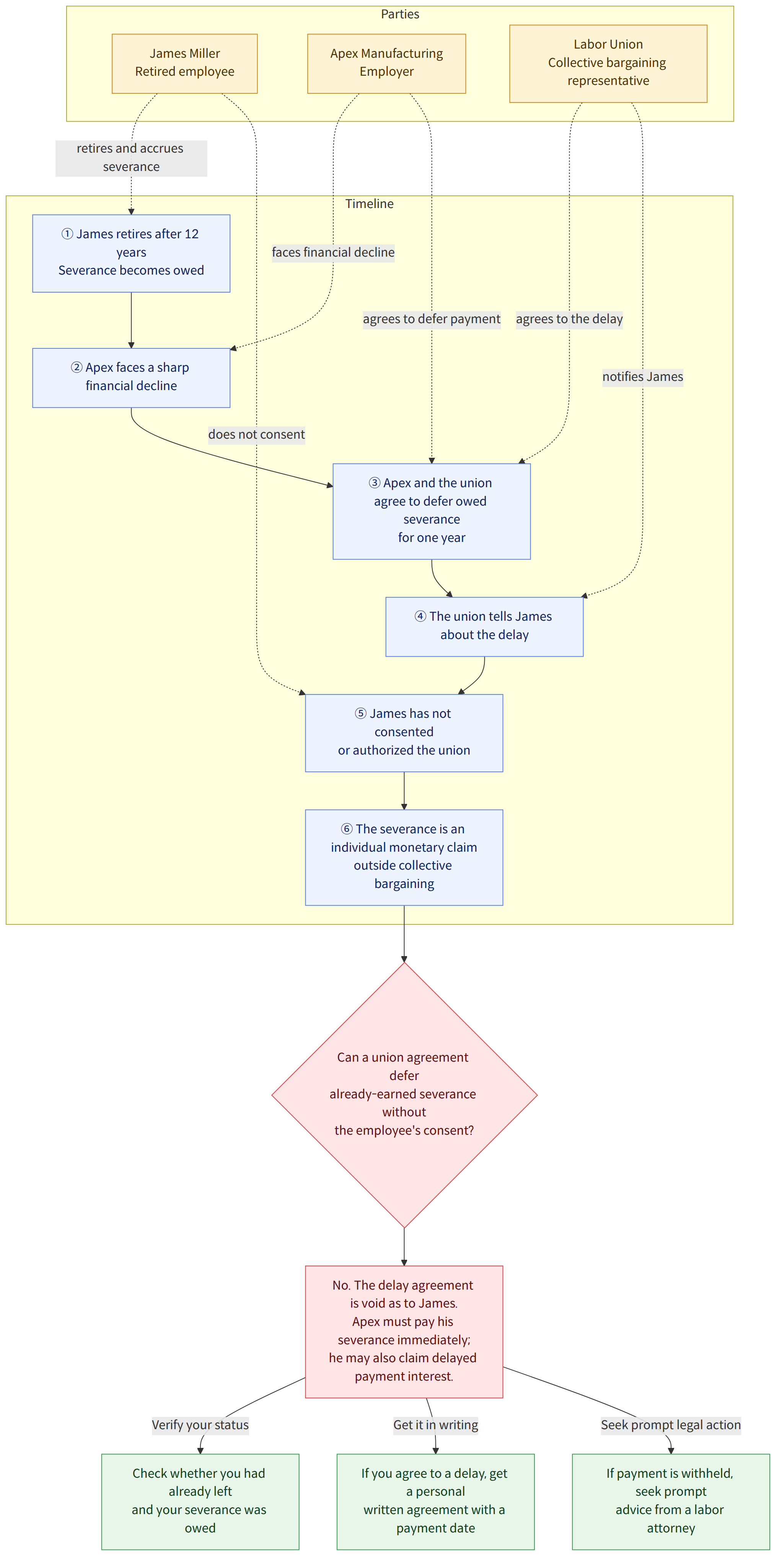
James Miller had spent twelve years at Apex Manufacturing, believing in the company's vision and working tirelessly through the lean years. When he finally decided to retire last autumn, he did so with the expectation that his accrued severance pay—a substantial sum meant to bridge the gap to his pension—would be deposited into his account within two weeks of his departure.
However, Apex was crumbling. Just weeks after James left, the company's financial situation plummeted. In a desperate bid to keep the factory doors open, the company management sat down with the Labor Union. Together, they signed a "Survival Agreement," a collective bargaining agreement stating that all severance payments already owed to departed employees would be deferred for one full year to preserve the company's remaining liquidity.
James received a cold notification from the union representative: "We've agreed to a one-year delay to save the company. We're all in this together, James." But James wasn't "in this together" anymore—he was a retired employee with bills to pay and no voice in the union's recent negotiations.
The Legal Question
Can a collective bargaining agreement between an employer and a labor union legally postpone the payment of severance pay that has already been earned and is currently owed to an individual employee, even if that employee never personally agreed to the delay?
What Korean Law Says
Under Korean labor law, there is a sharp distinction between future working conditions (which a union can negotiate) and accrued rights (which belong solely to the individual).
The Principle of Private Property Rights: Once a worker retires, the right to receive severance pay is no longer a matter of "working conditions" to be negotiated; it becomes a concrete monetary claim—effectively, private property.
For a payment that has already been earned to be waived or delayed, the following must occur:
- Individual Consent: The specific employee must explicitly agree to the delay.
- Specific Authorization: The employee must have granted the union a specific power of attorney to negotiate the disposal of their personal assets.
How Korean Courts Approach This
Korean courts maintain a strict protective stance toward earned wages and severance pay. The judicial consensus is that while a union has the power to negotiate how people will be paid in the future, it does not have the power to give away money that already belongs to the worker.
Courts generally rule that because earned severance pay has moved into the "private property sphere" of the worker, it is beyond the scope of collective bargaining. Any agreement that attempts to dispose of these individual rights without individual consent is viewed as a violation of the worker's property rights.
Applying the Law to the Case
In the case of James Miller, we must look at the timeline of his rights:
- The Right was Fixed: The moment James retired, his severance pay was calculated and became a debt the company owed him. It was no longer a "condition of employment" but a "debt of money."
- The Union's Overreach: The "Survival Agreement" was a collective bargain. While the union can negotiate for current employees, it cannot unilaterally decide the fate of James's personal property.
- Lack of Consent: James never signed a waiver, nor did he give the union the authority to postpone his payment.
Because the payment was already "accrued," the union's agreement to defer it for one year is legally void as it pertains to James.
Conclusion: What Happened, and What Should You Do?
The Result: James is legally entitled to his severance pay immediately. The collective agreement signed by the union cannot be used as a legal shield by Apex Manufacturing to withhold his funds. James can successfully demand payment and, if necessary, file a claim for delayed payment interest.
Practical Tips for Workers:
- Verify Your Status: If you have already left a company, remember that your earned wages and severance are your private property. Do not assume that "union agreements" apply to funds already owed to you.
- Get it in Writing: If you do choose to help a struggling former employer by delaying your payment, ensure you sign a personal agreement that includes a guaranteed payment date and a penalty for further delays.
- Seek Prompt Legal Action: If a company cites a collective agreement to deny you earned pay, consult a labor attorney immediately. The law is heavily weighted in favor of the individual when it comes to accrued property rights.