1. A Human Story
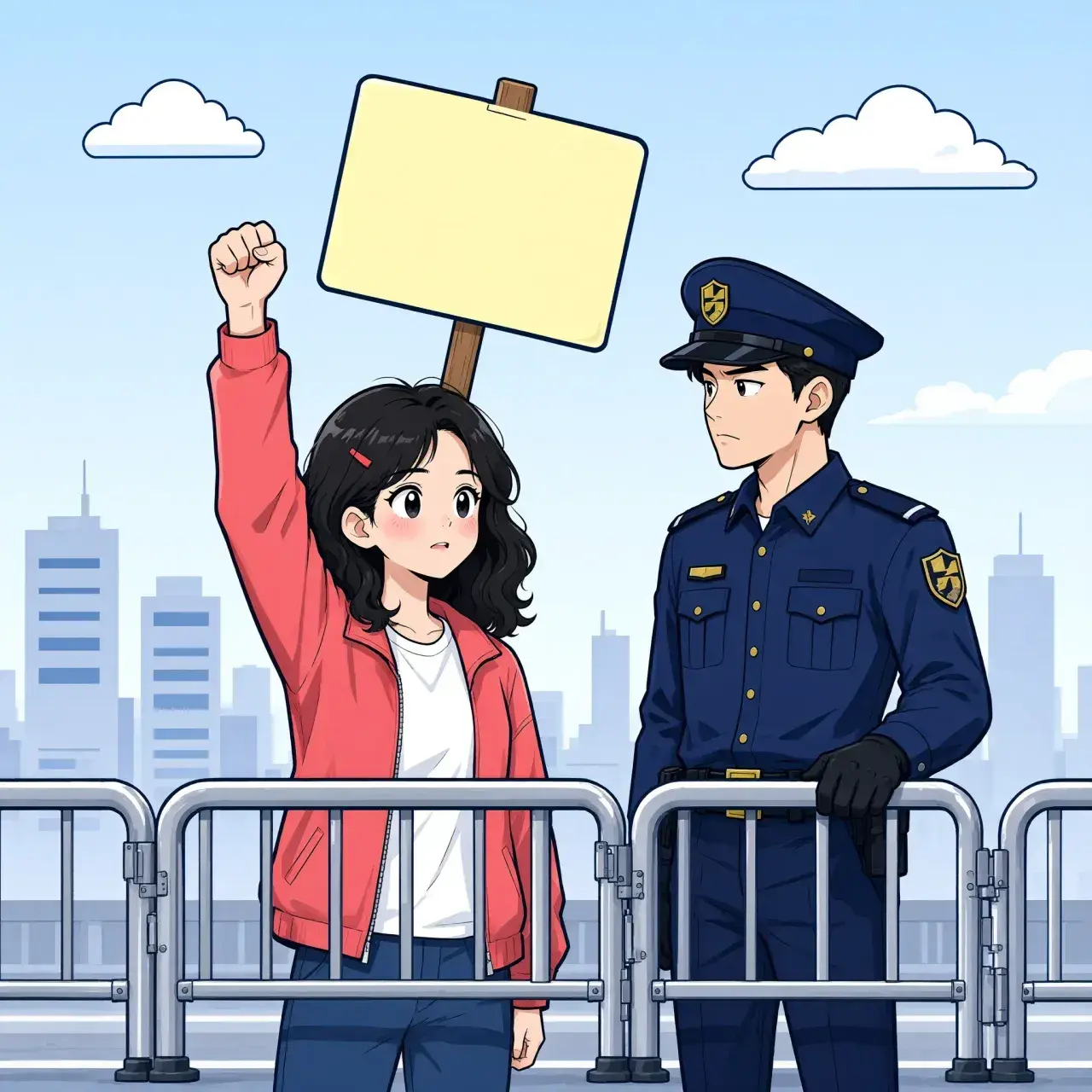
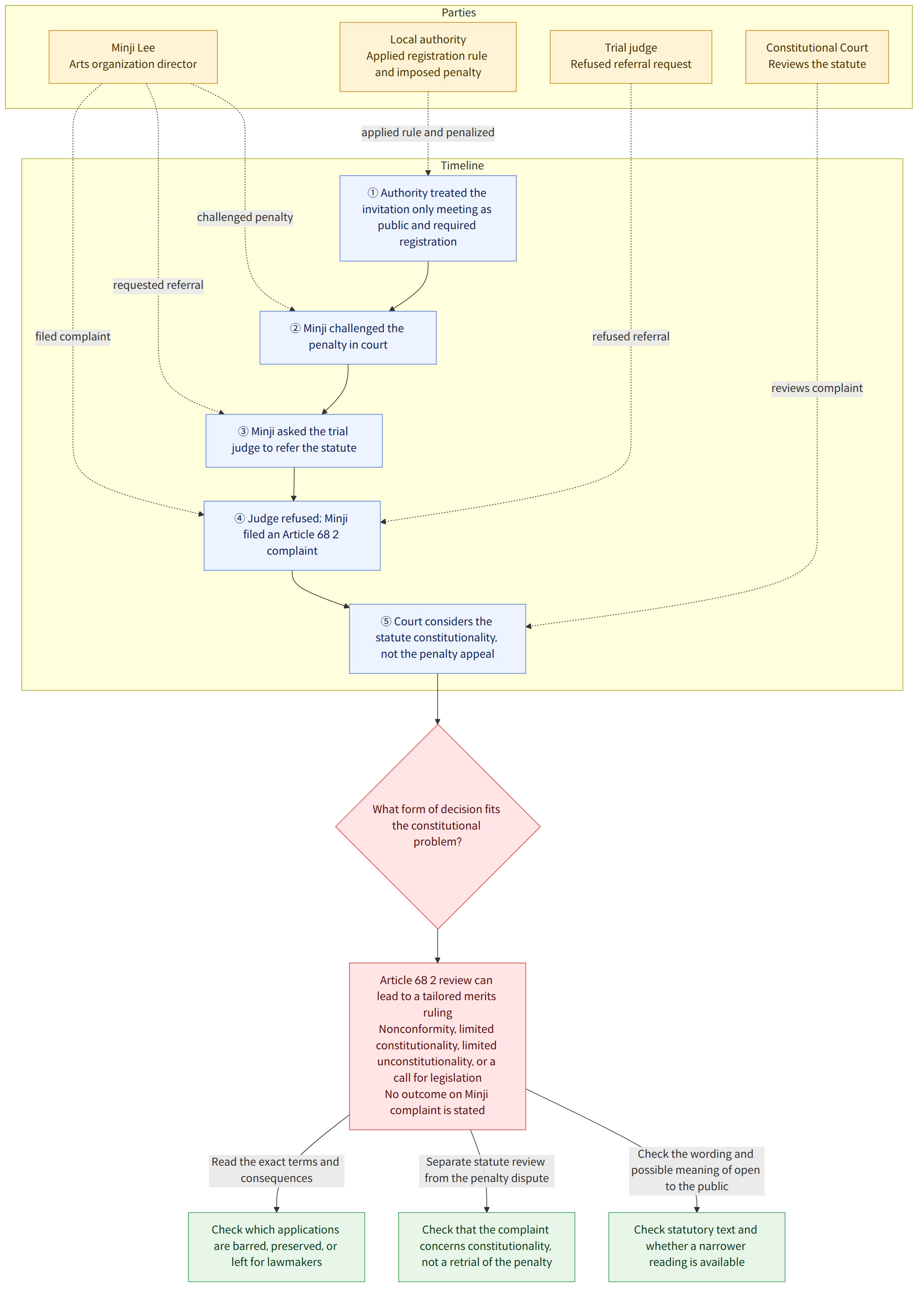
Minji Lee ran a small community arts organization in Busan. One evening, she held a support meeting for families caring for relatives with serious illnesses. The meeting was advertised through the organization’s newsletter, but attendance required a personal invitation; it was not open to the public.
A local authority nevertheless treated the gathering as an event requiring registration under a fictional statute that applied to events “open to the public.” Minji challenged the resulting penalty in court, arguing that the law was being applied too broadly. She asked the trial judge to refer the relevant provision to the Constitutional Court. The judge refused. Minji then filed a constitutional complaint under Article 68(2) of the Constitutional Court Act—and asked her lawyer what kinds of decisions the Constitutional Court could make.
2. The Legal Question
When a person brings a constitutional complaint under Article 68(2), must the Constitutional Court simply declare the challenged statute constitutional or unconstitutional? Or can it issue a more tailored decision that preserves the law in some circumstances, identifies a constitutional defect without immediately invalidating it, or calls on the legislature to act?
3. What Korean Law Says
Article 68(2) provides a route to constitutional review for someone involved in a court case who has asked the trial court to refer a statute for review and whose request has been rejected. The complaint concerns the constitutionality of the statute; it is not an appeal asking the Constitutional Court to decide the underlying case all over again.
A modified decision is a decision on the merits that takes a form other than a straightforward declaration that the challenged law is constitutional or unconstitutional.
The principal forms include:
- Constitutional nonconformity: The Court finds a constitutional problem but refrains from immediately striking down the provision when doing so could intrude on the legislature’s choices or create a serious legal gap or disruption. The decision identifies the defect and may leave lawmakers to revise the law under conditions set by the Court.
- Limited constitutionality: The Court upholds a provision only on a particular, constitutionally permissible interpretation. The text may reasonably bear more than one meaning, and the Court narrows its application to the meaning compatible with the Constitution.
- Limited unconstitutionality: The Court rules that a provision is unconstitutional when it is applied in a particular area or given a particular meaning, without necessarily invalidating every possible application of the provision.
- A decision urging legislation: The Court may call on lawmakers to amend or supplement a law that is not yet unconstitutional but risks becoming so if left unchanged.
These decisions are not interchangeable labels. Each addresses a different relationship between the wording of a law, its practical effects, and the constitutional problem before the Court.
4. How Korean Courts Approach This
The Constitutional Court’s task is to protect the Constitution while respecting the roles of the legislature and the ordinary courts. A ruling that immediately removes a provision can sometimes leave people and public authorities without a workable legal framework. In that situation, the Court may identify the constitutional defect without producing an abrupt legal vacuum.
Where a provision can bear several meanings, the Court may consider whether a narrower interpretation can keep it within constitutional bounds. A limited-constitutionality ruling preserves the law only within that permissible reading; it does not give officials a license to keep using a broader, unconstitutional interpretation. Conversely, a limited-unconstitutionality ruling marks the particular interpretation or application that cannot stand.
A legislative exhortation is different again: it signals that the law needs attention, even though the Court has not concluded that it is presently unconstitutional. The precise consequences of any ruling depend on its terms and on the law at issue. The Court does not choose among these forms as a matter of convenience; the constitutional problem determines which response is appropriate.
5. Applying the Law to the Case
Minji’s complaint raises a question about both the statutory language and the way the authority applied it.
- Her route to review is the statute’s constitutionality. After the trial judge refused her request for a referral, Article 68(2) provided a way to bring the constitutional issue before the Constitutional Court. That filing does not itself decide whether the penalty was properly imposed.
- The wording may allow a narrower reading. In this fictional example, “open to the public” could be read broadly to include almost any organized gathering, or more narrowly to mean an event that members of the public can attend without a personal invitation. The latter reading is consistent with the provision’s ordinary wording and avoids sweeping private meetings into its reach.
- A limited-constitutionality ruling could address the problem. If the Court concluded that the provision was constitutional only when “open to the public” meant genuinely accessible to the public, it could uphold the law on that restricted interpretation. The authority could not rely on the broader interpretation to treat Minji’s invitation-only meeting as a covered event.
- The ordinary court would still resolve the penalty dispute. The Constitutional Court’s role would be to rule on the constitutional meaning or validity of the provision. The trial court would then apply that ruling to the facts, including whether Minji’s meeting was in fact invitation-only.
Other outcomes would be possible if the constitutional issue were different. For example, if the Court found a serious defect but immediate invalidation would disrupt an essential legal scheme, it might issue a constitutional-nonconformity decision. If the law were not yet unconstitutional but needed revision to avoid a future problem, it might urge legislative action instead.
6. Conclusion: What Happened, and What Should You Do?
In Minji’s fictional case, the Constitutional Court adopts the narrow reading: the registration rule applies only to events genuinely open to the public, not to a gathering that requires personal invitations. The trial court then applies that interpretation to her case. Because the meeting was invitation-only, the authority’s broad reading cannot support the penalty, and the penalty is set aside.
For readers facing a similar dispute:
- Identify the precise challenge. Explain which statutory words or applications you believe conflict with the Constitution, and connect that issue to your pending court case.
- Keep a clear record of the facts. Documents such as invitations, attendee lists, notices, and official decisions may matter when the ordinary court applies the Constitutional Court’s ruling.
- Get advice promptly. Article 68(2) complaints are subject to procedural requirements and deadlines; consult a Korean lawyer as soon as the trial court rejects a request for referral.