The Ministry of Justice (법무부) has announced plans to ease the burden of providing financial proof of tuition and living expenses for international students with Korean-language proficiency, and to expand visa pathways leading from study to job-seeking, employment and long-term residence. The proposal includes exempting students who have achieved Level 4 or higher on the Test of Proficiency in Korean (한국어능력시험; TOPIK) or completed Level 4 of the Social Integration Program (사회통합프로그램) from separately proving their financial means. The government also plans to create a visa pathway for gap-year study and simplify part-time work rules.
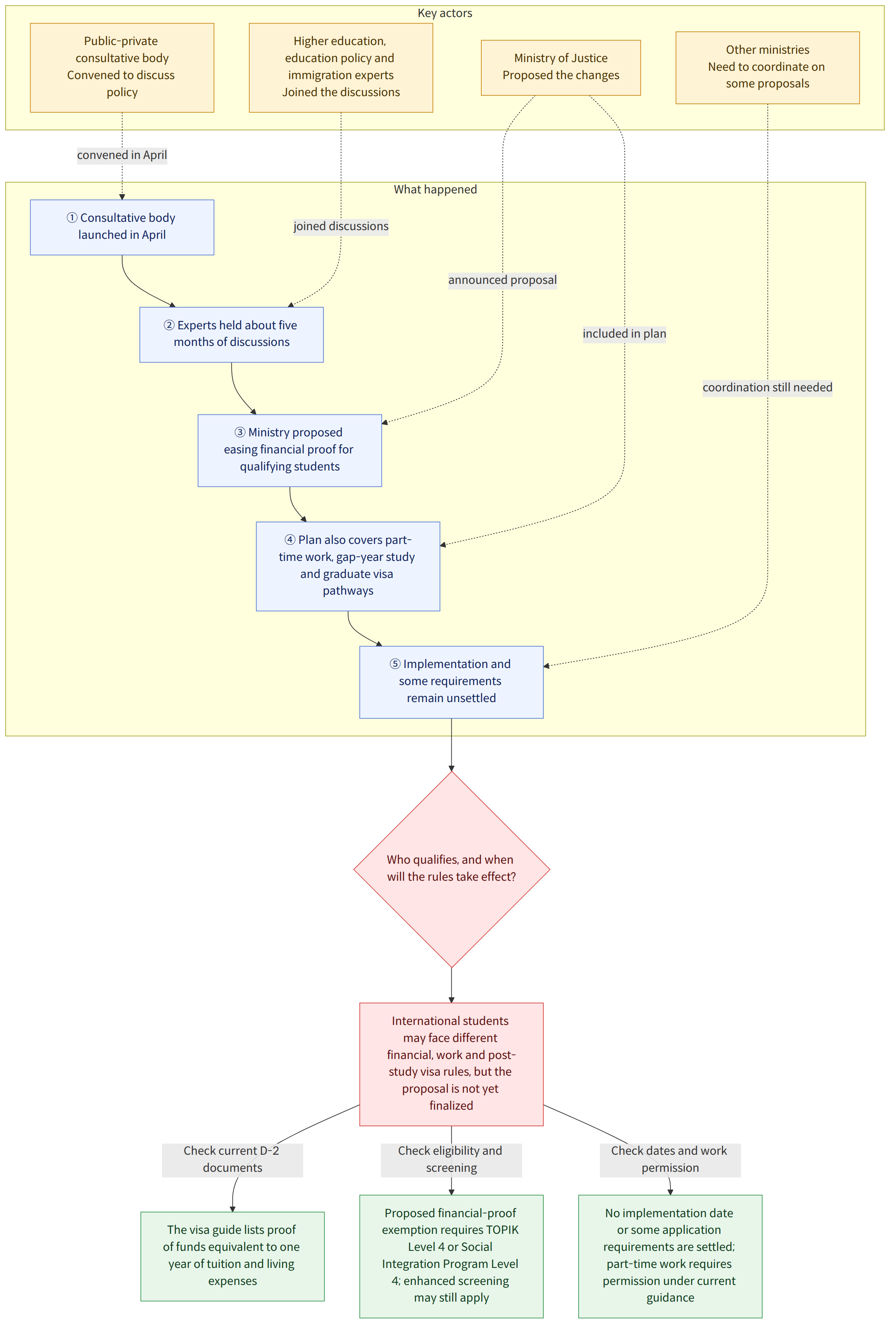
This plan is a government proposal, not a set of finalized regulations or guidance on measures already in effect. Measures within the Ministry of Justice’s authority are to begin implementation this year, while proposals requiring coordination with other ministries are to be developed following further government discussions.
Background and context
The number of international students living in South Korea rose from about 200,000 in 2022 to more than 300,000 last year, reaching about 350,000 as of August. The proposal is the result of about five months of discussions by a public-private consultative body involving experts in higher education, education policy and immigration, which was launched in April.
The Ministry of Justice said it would shift policy beyond recruiting international students to supporting their education, employment and long-term settlement. In other words, the plan is to revise not only the financial requirements at the time of admission but also the conditions for working while studying and the pathways to job-seeking and employment after graduation.
The proposed exemption from financial proof would not apply to all international students. The announced criteria are TOPIK Level 4 or higher or completion of Level 4 of the Social Integration Program. By contrast, the government plans to expand a system requiring applicants who face more intensive screening because of a higher risk of overstaying or working without authorization to keep their study funds in an account for a specified period. It is therefore important to check whether an applicant falls into a category subject to screening, regardless of whether they meet the Korean-language criteria.
What this means
Financial-documentation requirements may change at the stage of applying for a student visa, while requirements and paperwork for part-time work may change during a student’s studies. For graduates, the plan is to vary the length of stay on a job-seeking visa from one to three years according to their Korean proficiency and employment readiness, and to create a pathway for eligible science and engineering students to change to an E-7 work visa and work in designated fields, including manufacturing.
The government is also pursuing a “K-Tech Master Visa” for graduates of specialized technical master’s programs. If implemented along the lines proposed by the Ministry of Justice, it would be an effort to create a pathway from study to employment and long-term residence. However, announcing a visa name does not mean its eligibility criteria or application procedures have been finalized.
Whether the measures will actually apply depends on the implementation date and detailed requirements, so applicants should not assume that an exemption or a particular period of stay is guaranteed based solely on the announced plans.
Related programs and support information
According to the in-house visa guide, the student visa (D-2) is a status of stay for foreign nationals seeking to pursue a regular course of study or conduct specific research at an eligible junior college or higher-education institution, or an academic research institution. The documents currently listed for student visa applications include evidence of an amount equivalent to one year of tuition and living expenses. The government’s proposed exemption from financial proof would apply this requirement differently to applicants who meet the specified Korean-language standards. Before it takes effect, applicants should check their application date and whether they are covered.
Part-time work while studying is not automatically permitted either. According to the guide, international students may work after receiving permission, and the permitted hours and conditions vary depending on factors such as Korean proficiency and academic performance. Applications may require an alien registration card and passport, proof of grades or attendance, evidence of language proficiency, a part-time work confirmation form, and an employment contract. If the employer or workplace changes, new permission may be required. Working before checking the conditions of the permit or violating those conditions may result in penalties.
The activities permitted and requirements for a job-seeking visa (D-10) vary depending on the category, such as seeking a professional job or preparing to start a business. The guide lists documents to prove eligibility, such as a degree or points-based qualifications, as well as an activity plan and documents related to place of residence and living expenses. The Ministry of Justice’s announced plan to vary graduates’ periods of stay could change these existing job-seeking pathways, but it has not yet specified how Korean proficiency and employment readiness will be assessed.
The Ministry of Justice plans to establish five visa and residence support centers for international students at regional immigration offices, so that visa applications and related procedures can be handled in one place. It also said it would create an online platform providing guidance on changing status of residence according to eligibility, as well as checklists by occupation for work visas. The actual start dates for the centers and guidance services need to be confirmed separately.
Points reported differently across news outlets
Reports differ in their descriptions of the current rules for the length of stay on a job-seeking visa for graduates. One report said the new plan would vary the D-10 period from one to three years according to graduates’ Korean proficiency and employment readiness. Another said the new proposal would grant up to three years to STEM graduates and skilled workers, and described the current general standard as one to two years. The in-house visa guide says that the period granted at one time is generally up to one year, while the overall maximum, including extensions, is up to three years or one year depending on eligibility. These standards do not use the same scope or distinctions in their explanations, making it difficult to treat the details of the new system as current regulations.
Reports also used different reference points when comparing the number of international students. One said the number rose from about 200,000 in 2022 to more than 300,000 last year, reaching about 350,000 as of August. Another said it had risen from 17,000 about 20 years ago to more than 350,000 this fall. These figures compare different reference periods.
What is confirmed and what is not yet known
What is confirmed
- The proposed criteria for exemption from financial proof are TOPIK Level 4 or higher or completion of Level 4 of the Social Integration Program.
- The government plans to simplify part-time work eligibility, focusing on Korean proficiency and academic performance, while raising the Social Integration Program language requirement to Level 3.
- The government plans to vary D-10 periods of stay from one to three years according to graduates’ Korean proficiency and employment readiness.
- The plan includes a pathway to change to an E-7 visa for eligible science and engineering students, the K-Tech Master Visa, and a Gap Year Visa (갭이어 비자).
- The government plans to establish five support centers for international students at regional immigration offices.
What is not yet known
- When the exemption from financial proof for international students who meet the Korean-language standards will take effect.
- What the specific eligibility criteria and period of stay for the Gap Year Visa will be.
- What the detailed eligibility requirements and application procedures for the K-Tech Master Visa will be.
- What criteria will be used to assess Korean proficiency and employment readiness when determining D-10 periods of stay.
What readers should check
- When applying for or extending a student visa, check whether the exemption from financial proof has actually taken effect and whether it applies to your Korean-language results and residence history. Announcing a plan does not by itself change the documents required for existing applications.
- Begin part-time work only after receiving permission, and check whether new permission is required if your workplace or employer changes. It is also safer to review the documents and conditions listed in the student visa guide before applying.
- If you are preparing to seek a job or employment after graduation, first check the current eligibility requirements and permitted activities for D-10 and E-7 visas, and consult immigration guidance to see whether the implementation date and detailed criteria for the new pathways have been announced.