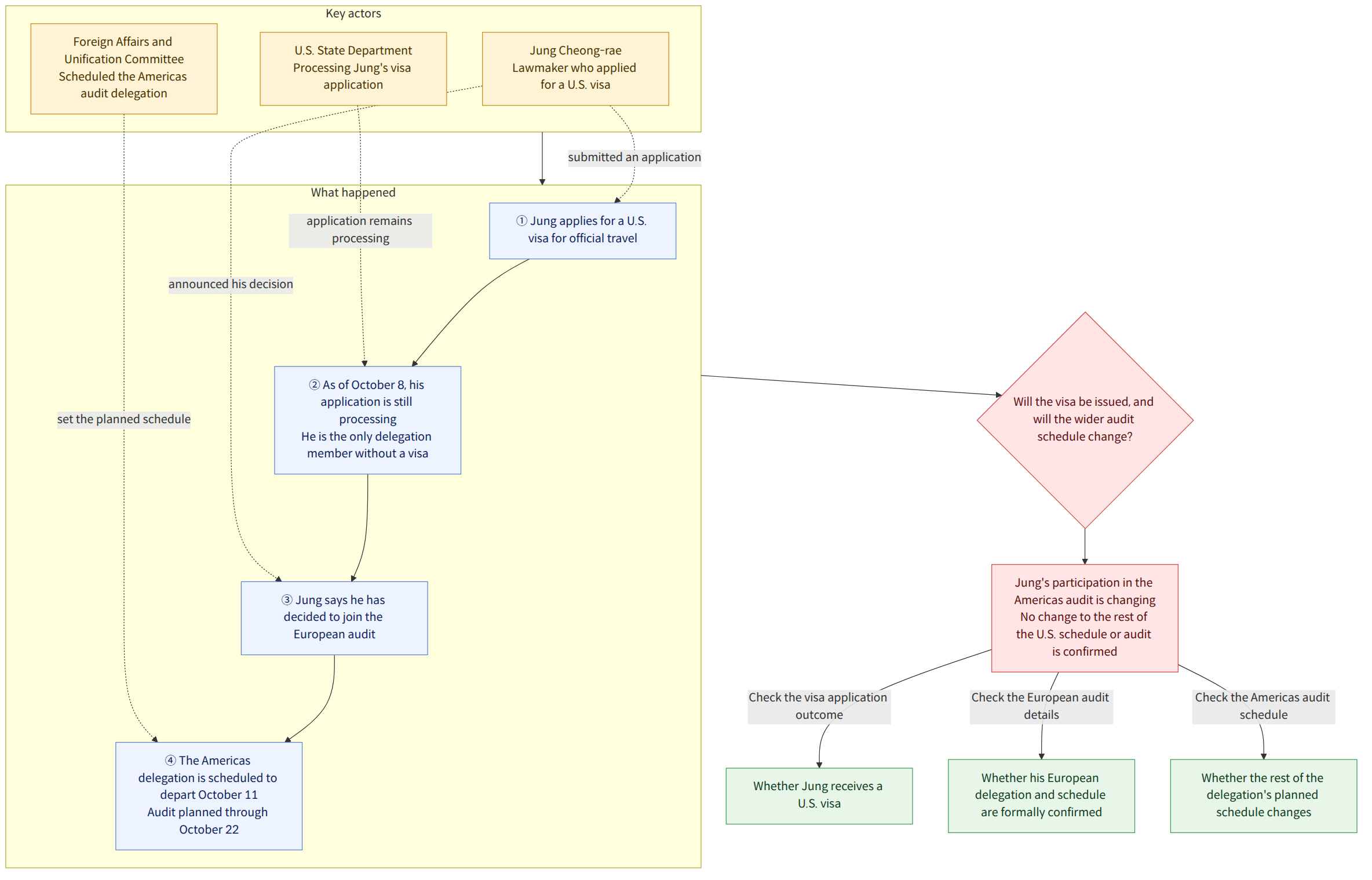
As of October 8, 2026, three days before the Americas delegation of the National Assembly’s Foreign Affairs and Unification Committee (국회 외교통일위원회) was due to depart for the United States, only Democratic Party of Korea (더불어민주당) lawmaker Jung Cheong-rae had not received a U.S. visa. Jung said he had applied to the U.S. State Department for a visa for official travel but, because his application was still being processed, had decided he would have to join the European parliamentary audit instead. The specific reason for the visa delay and the outcome of the application have not been confirmed.
Background and context
The Americas delegation consisted of seven members: Committee Chair Song Seok-jun; People Power Party (국민의힘) lawmakers Ko Dong-jin and Kim Geon; Democratic Party lawmakers Maeng Seong-gyu, Park Seong-jun and Jung Cheong-rae; and independent lawmaker Han Dong-hoon. They were scheduled to depart on October 11 and, over 12 days and 9 nights, audit the Embassy of the Republic of Korea in the United States (주미 한국대사관), the Permanent Mission of the Republic of Korea to the United Nations (주유엔 대표부) and other sites through October 22.
According to lawmakers on the Foreign Affairs and Unification Committee, Jung was the only member of the Americas delegation whose visa had not been issued ahead of departure. A committee official said, in effect, that if the visa had not been issued by October 8, with departure scheduled for the 11th, there would be no further chance for it to be issued. This indicates that the schedule was tight at the time, but does not mean the visa application had already received a final decision.
In a Facebook post, Jung expressed regret, saying he did not know why his application was still being processed, and said he would do his utmost to serve South Korea’s national interests through his legislative work, wherever he was assigned. Democratic Party leader Kim Min-seok also posted on X, expressing strong regret over the visa delay and saying he hoped the South Korean and U.S. diplomatic authorities would resolve the issue swiftly and proactively.
Jung was also unable to take part in the Americas parliamentary audit in October 2013 because he did not receive a U.S. visa, and moved to the European audit delegation at the time. By contrast, in 2012 he received a single-entry visa and took part in the Americas audit, and in January 2014 he visited the United States as the secretary of the National Assembly’s Intelligence Committee. These past cases alone cannot explain the cause of the current visa delay.
What this news means
The matter could affect not only an individual’s overseas travel for official duties but also the regional participation and schedules of the National Assembly audit delegation. Jung said he had decided to join the European audit, so at least his own plans to participate in the Americas delegation are changing. However, there is no confirmation that the rest of the delegation’s U.S. schedule or the audit itself has been canceled or changed.
Because the reason the visa was not issued has not been disclosed, it is difficult to draw a definite connection to Jung’s past activities or to diplomatic tensions. Reports at the time said some observers speculated that his involvement in a 1989 sit-in occupation of the U.S. ambassador’s residence by an action squad of Jeondaehyeop (전대협) may have affected the visa issuance, but no link to the current application has been confirmed. The fact that he received a visa in 2012 and visited the United States in 2014 also does not reveal the basis for the current decision.
For example, if Jung’s participation in the European audit is formally confirmed, the key details for readers to check will be which audit delegation he joins and what schedule he follows in Europe. Those details are not included in the information currently available. For now, the U.S. visa-processing delay, Jung’s decision to join the European audit, and the Americas delegation’s planned audit schedule should be considered separately.
What is confirmed and what remains unknown
Confirmed
- Reports said that, as of October 8, Jung was the only member of the Americas delegation who had not received a U.S. visa.
- The Americas delegation has seven members and was scheduled to depart on October 11 and audit the Embassy of the Republic of Korea in the United States, the Permanent Mission of the Republic of Korea to the United Nations and other sites through October 22.
- Jung said he had decided to join the European audit because his visa application was still being processed.
- Jung was also unable to receive a U.S. visa in 2013 and moved to the European audit delegation instead of joining the Americas audit.
Still unknown
- The specific reason for the delay in issuing Jung’s U.S. visa and the final outcome of his application
- Which audit delegation Jung will join for the European audit and what schedule he will follow
- Whether there have been any further changes to the Americas delegation’s audit schedule or membership
What readers should check
- Jung’s follow-up announcements may clarify whether he will take part in the European audit and identify the delegation and schedule.
- Readers should check whether the U.S. State Department discloses the outcome of the visa application and whether a hold on issuance is distinguished from a final refusal.
- Follow-up reporting can confirm whether the Americas delegation departed and carried out its audit according to the original schedule.
References
- Other coverage consulted: m.koreaherald.com