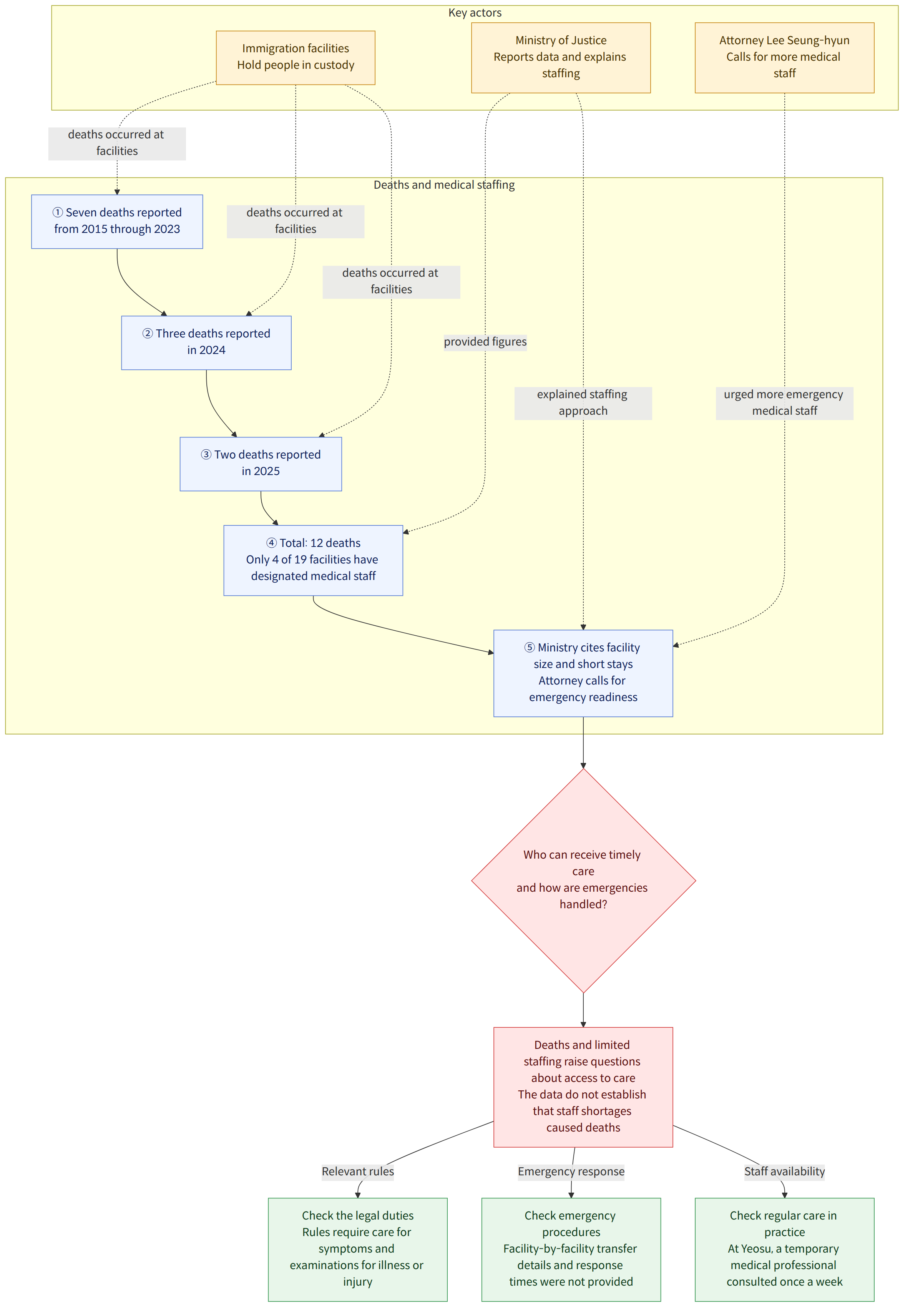
From 2015 to 2025, 12 people died while in custody at immigration detention facilities across the country. According to data from the Ministry of Justice (법무부), the causes of death in 3 of those cases have not been disclosed, and only 4 of the 19 facilities nationwide have designated medical staff. The deaths and staffing figures point to the need to consider both access to medical care and the safety of people held at immigration detention facilities.
Background and context
There were 7 deaths from 2015 through 2023. Two people died at each of the Hwaseong Foreigners’ Detention Center (화성외국인보호소) and Cheongju Foreigners’ Detention Center (청주외국인보호소), and one person died at each of the Seoul Southern Immigration Office (서울남부출입국사무소), Busan Immigration Office (부산출입국사무소) and Suwon Immigration Office (수원출입국사무소). In 2024, three people died, one each at the Seoul Southern Immigration Office, Cheongju Foreigners’ Detention Center and Cheongju Immigration Office (청주출입국사무소). In 2025, two people died, one each at the Gwangju Immigration Office (광주출입국사무소) and Chuncheon Immigration Office (춘천출입국사무소). No deaths in 2026 had been reported as of the time this article was written.
The causes of death have not all been confirmed. The causes in 3 of the 12 cases have not been disclosed; one of those deaths occurred in 2024 and two in 2025. The remaining deaths were classified as resulting from illnesses or serious health problems, including lung cancer, acute heart failure, acute myocardial infarction, acute pneumonia and end-stage liver cirrhosis.
These data alone do not establish that a shortage of medical staff caused the deaths. Details about the circumstances of each death, the individuals’ health and the length of their detention were not provided. However, the continuing reports of deaths in custody, along with the limited number of facilities with designated medical staff, provide grounds to examine whether people who need care are connected with medical professionals in a timely manner, both inside and outside the facilities.
What this means
Of the 19 immigration facilities nationwide, 4 have designated medical staff: the Hwaseong and Cheongju foreigners’ detention centers, and the Yeosu (여수출입국사무소) and Ulsan (울산출입국사무소) immigration offices. Even designated facilities may have only one doctor and one nurse. At the Yeosu Immigration Office, the previous doctor retired in December 2021 and a replacement could not be hired, so a temporarily employed medical professional has provided consultations once a week. Therefore, the label “facility with designated medical staff” alone does not establish whether regular medical care is available at each facility.
The Ministry of Justice said it had assigned medical staff to the four facilities with the largest populations in custody. It said the need for resident medical staff was relatively low at other facilities because they were smaller and detention periods were generally short, at about 10 days. It also said that foreign nationals in custody who report medical problems are connected with local medical institutions under agreement, and that 834 visits to outside medical institutions took place from January through August this year.
By contrast, attorney Lee Seung-hyun of the public-interest law organization Duru (공익법단체 두루) said deaths also occur at facilities without resident medical staff and called for more medical personnel to respond to emergencies and other situations. The difference between the two positions is whether staffing should be based on facility size and average detention periods, or whether the ability to respond to emergencies that may occur even at facilities without resident staff should also be considered.
For example, if someone held at a facility without resident medical staff reports a sudden change in their physical condition, how quickly they can be connected with a doctor at the facility or care at an outside medical institution may become important. However, the materials provided do not include information on emergency care and transfer procedures at each facility or response times.
Relevant regulations on medical care
Article 7-2 of the Enforcement Rule of the Immigration Control Act (출입국관리법 시행규칙) requires that foreign nationals in custody who show symptoms of a physical condition receive medical care from a doctor at the facility or at an outside medical institution. Article 21 requires immigration authorities to arrange health examinations for foreign nationals in custody who are ill or injured. In other words, the relevant regulations provide for medical care and examinations when someone has symptoms or a health problem.
However, according to the article, no law or regulation explicitly requires all immigration detention facilities to have resident medical staff. The existence of regulations on medical care and examinations is not the same as having resident medical staff at every facility. This is why it is necessary to check how staffing and connections with outside medical institutions work at each facility.
Regulations provide for access to medical care, but no requirement for resident medical staff at every facility has been identified.
What is confirmed and what remains unknown
Confirmed facts
- Twelve people died while in custody at immigration detention facilities between 2015 and 2025.
- The causes of death in 3 of the 12 cases have not been disclosed; the remaining deaths were classified as resulting from illnesses or serious health problems.
- Of the 19 immigration facilities nationwide, 4 have designated medical staff, and each designated facility may have only one doctor and one nurse.
- The Ministry of Justice said that 834 visits to outside medical institutions took place from January through August this year.
What remains unknown
- What were the specific circumstances and causes of death in the three cases for which the causes were not disclosed?
- What were the ages and nationalities of the 12 people who died, and how long was each person detained?
- When an emergency occurs at a facility without designated medical staff, what procedures are actually followed to provide care and arrange a transfer?
What readers can check
- To understand medical care at a particular facility, it is useful to check not only whether medical staff are designated, but also whether they are resident and how the facility connects people with outside medical institutions.
- If a person in custody reports a health problem, readers can check how medical care from a facility doctor or an outside medical institution is arranged under Article 7-2 of the Enforcement Rule, and whether a health examination is arranged under Article 21.
- When examining deaths in custody, readers should check whether the cause of death was disclosed and separately seek information on individual circumstances, detention periods and medical responses that are not included in the materials. The available evidence does not allow a determination of a causal relationship between medical staffing and deaths.