On October 6, 2026, the National Intelligence Service (국가정보원) said it was “not true” that the U.S. government had put on hold visa issuance and approval of diplomatic status for NIS staff it planned to assign to the Embassy of the Republic of Korea in the United States (주미한국대사관). It also said the two countries were consulting closely about the visa-processing delays. However, reports and the NIS’s explanation characterize the nature and causes of the delays differently, and it is not yet known when the procedures will actually be completed.
Background and context
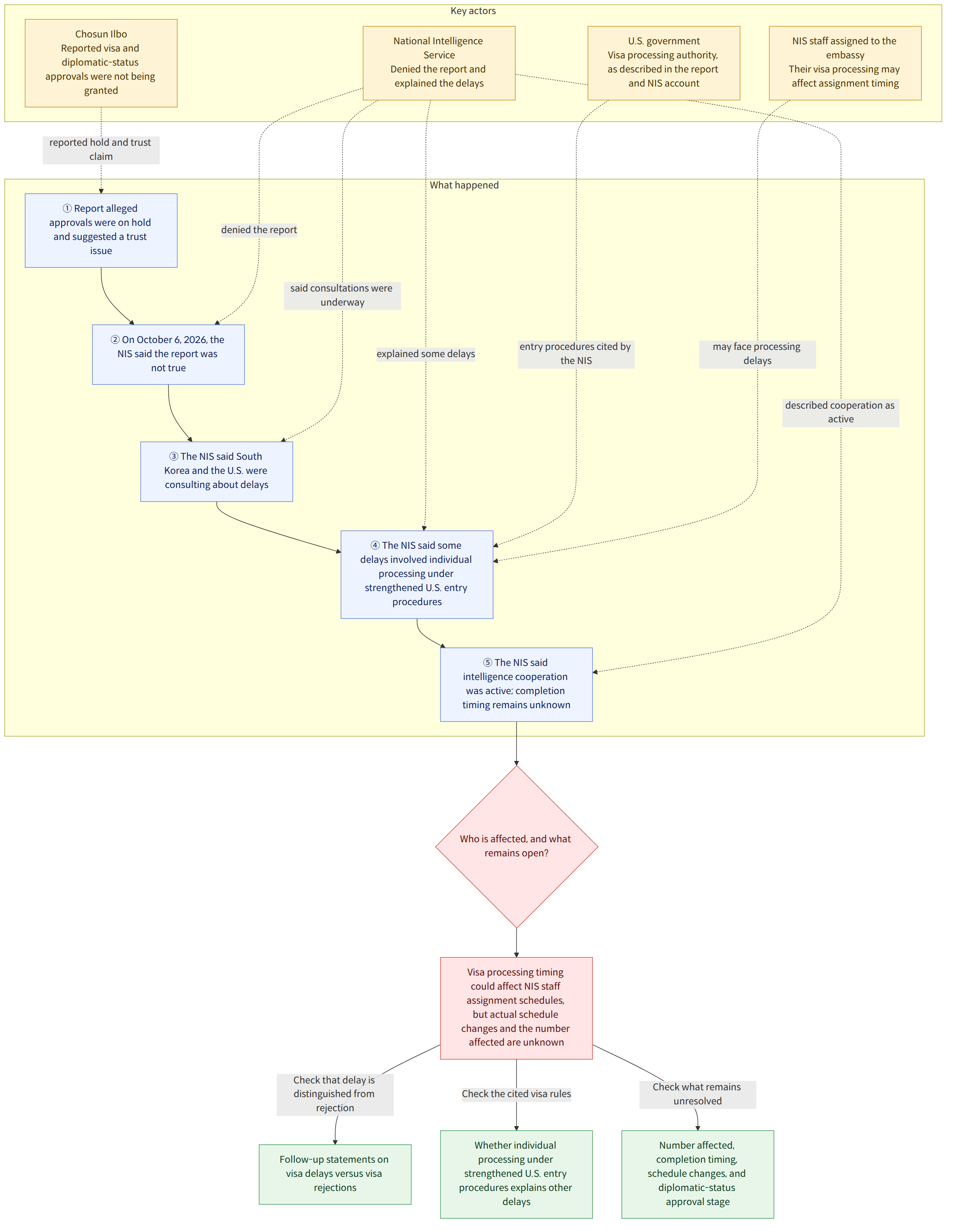
The Chosun Ilbo (조선일보) reported that the U.S. government was not approving NIS staff whom South Korea had sought to send to Washington as diplomats, and suggested that the reason was a lack of trust between South Korea and the United States. The NIS denied the report and said the two countries were consulting about the visa delays.
The NIS said some of the delays involved visa processing related to individuals’ personal information under strengthened U.S. entry procedures. This explanation focuses on distinguishing visa processing issues from South Korea-U.S. intelligence cooperation. However, since it explained the reasons for only “some” of the delays, it cannot be assumed that all the delays have the same cause.
What is currently confirmed is that the NIS denied the report and said consultations were underway about the visa delays. No basis has been presented for treating the report’s claim that approvals were put on hold, or its interpretation that the cause was a trust issue, as established fact.
The NIS expressed regret over what it called distorted reporting on matters related to intelligence agency activities and urged caution in covering the issue. It also said intelligence cooperation between South Korea and the United States was active. This, too, is the NIS’s account; the publicly available evidence does not confirm the specific nature of the cooperation or how it relates to the assignment process.
What this news means
The distinction to make in this controversy is between a delay in visa processing and the claim that the U.S. government rejected visas or diplomatic status. The NIS said reports of a “rejection” were untrue and explained that some delays involved individual visa processing. Therefore, based only on what has been made public, it is difficult to conclude that the assignments were rejected—or, conversely, that all procedures have been completed as normal.
The timing of visa processing could affect the actual assignment schedule for staff preparing to be posted. For example, if an employee’s visa application is still being processed, it may be difficult to confirm that employee’s departure or start-of-work date. However, publicly available materials do not say whether schedules have actually changed or how many staff members have been affected by delays.
Regarding South Korea-U.S. intelligence cooperation, two points are drawing attention: the NIS’s statement that cooperation is active, and the report’s suggestion that a lack of trust between the two countries was the cause. But visa delays alone cannot be used to assess the state of intelligence cooperation. The NIS said the two matters were unrelated, and no details have been made public that would allow that explanation to be independently verified.
Confirmed facts and what remains unknown
Confirmed facts
- On October 6, 2026, the NIS said reports that the U.S. government had put visa issuance and approval of diplomatic status on hold were untrue.
- The NIS said South Korea and the United States were consulting closely about the visa delays.
- The NIS explained that some delays involved visa processing related to individuals’ personal information under strengthened U.S. entry procedures and were unrelated to South Korea-U.S. intelligence cooperation.
- The NIS said intelligence cooperation between South Korea and the United States was currently active.
What remains unknown
- The number of staff whose visa processing has been delayed and when each person’s procedure is expected to be completed have not been made public.
- It has not been confirmed whether there are specific reasons for the delays beyond the strengthened U.S. entry procedures.
- It is also unknown whether assignment schedules have actually changed or what stage the diplomatic-status approval process is at.
What readers should check
- In follow-up statements, it is worth checking whether “visa delays” and “visa rejections” are clearly distinguished. The NIS has denied reports of rejections and said consultations are underway.
- Any new information about the number of people affected, when procedures will be completed, and whether assignment schedules have changed would help establish the scope of the actual impact.
- Claims about South Korea-U.S. intelligence cooperation should be assessed by checking whether information verifiable independently of the NIS’s account is available. The publicly available evidence currently contains no specifics about the cooperation.