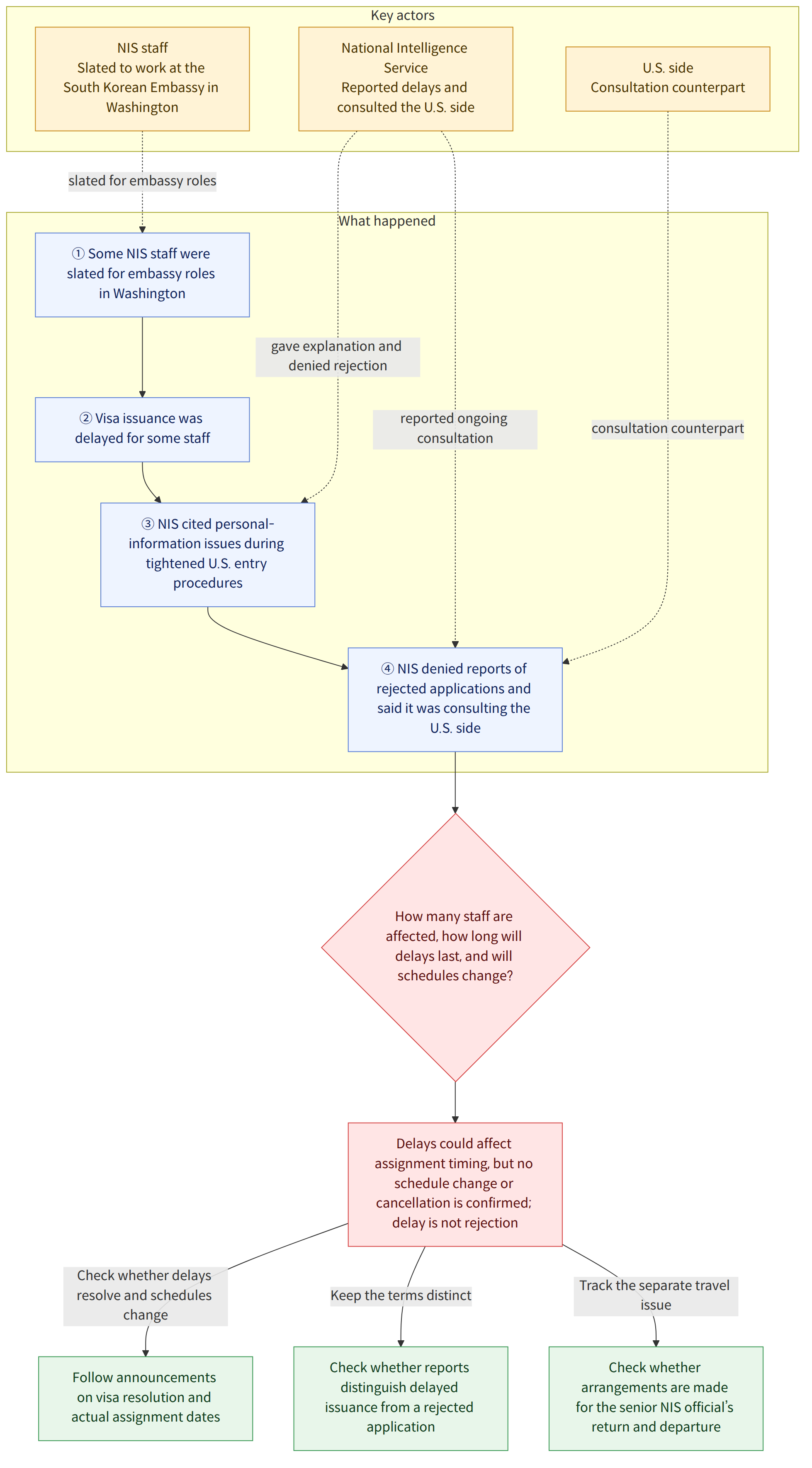
South Korea’s National Intelligence Service (국가정보원) said Tuesday that it is consulting with the U.S. side after visas were delayed for some staff slated to work at the South Korean Embassy in Washington. The NIS denied reports that the employees’ visa applications had been rejected. The delay in visa issuance has been confirmed, but it should be distinguished from a rejection of the applications.
Background and context
The Chosun Ilbo (조선일보) reported that the U.S. government had not approved a request to send NIS personnel to Washington as diplomats. It also reported that Washington and Seoul had yet to reach an agreement on the departure of a senior NIS official who needs to return to South Korea.
The NIS said the delays in some visa applications stemmed from issues involving applicants’ personal information during tightened U.S. entry procedures. It added that it was in close consultation with the U.S. side. However, it did not disclose what personal information issues arose or at what stage of the process the delays occurred.
The NIS dismissed claims that the visa delays were connected to broader tensions between South Korea and the United States, including disputes related to Coupang or allegations concerning intelligence activities. The explanation currently confirmed is the NIS’s stated issue involving personal information during entry procedures; the NIS has denied claims linking the delays to other disputes.
What this news means
Because the employees whose visas are delayed are slated to work at the South Korean Embassy in Washington, continued delays could affect when they are actually assigned there. However, the information currently available does not establish whether the assignment schedule has changed or whether a staffing gap has arisen. Visa delays alone should not be interpreted as meaning that the assignments have been canceled.
For example, if the scheduled start date arrives before an employee’s visa is issued, the assignment schedule might need to be adjusted. This is a hypothetical example of a possible situation, not an indication that any schedule adjustment has actually been made. The scope of the impact is also difficult to assess because the number of employees affected, the length of the delays, and the types of visas have not been confirmed.
The return and departure issues involving the senior NIS official also remain unresolved. If the Chosun Ilbo report is accurate, the two sides have not reached an agreement, but the information provided does not establish whether this issue is directly connected to the visa delays or what procedures will be used to resolve it. For that reason, the outcomes of further consultations should be considered separately in terms of the staff assignments and the official’s travel.
What is known and what remains unclear
What is known
- The NIS said visa issuance for some employees had been delayed and that it was consulting with the U.S. side.
- The employees were slated to work at the South Korean Embassy in Washington.
- The NIS denied media reports that the visa applications had been rejected.
- The NIS cited issues involving applicants’ personal information during tightened U.S. entry procedures as the reason for the delays.
- The NIS dismissed claims linking the delays to tensions between South Korea and the United States, including disputes related to Coupang or allegations concerning intelligence activities.
What remains unclear
- The number of employees whose visas have been delayed and the length of the delays have not been disclosed.
- The types of visas the employees applied for have not been confirmed.
- It is not known how the return and departure issues involving the senior NIS official will be handled.
- It has not been confirmed when consultations with the U.S. side will conclude or whether the assignment schedule has changed.
What readers should look for
- In follow-up announcements, readers should check whether the visa delays have been resolved and distinguish that from whether the actual assignment schedule has changed.
- Because rejection of a visa application and a delay in visa issuance are separate matters, readers can check whether reports use the two terms interchangeably.
- Readers should check separately for information on whether an agreement has been reached and what arrangements will be made regarding the senior NIS official’s return and departure.